
Hardening a 10K+ Distributed Server Fleet
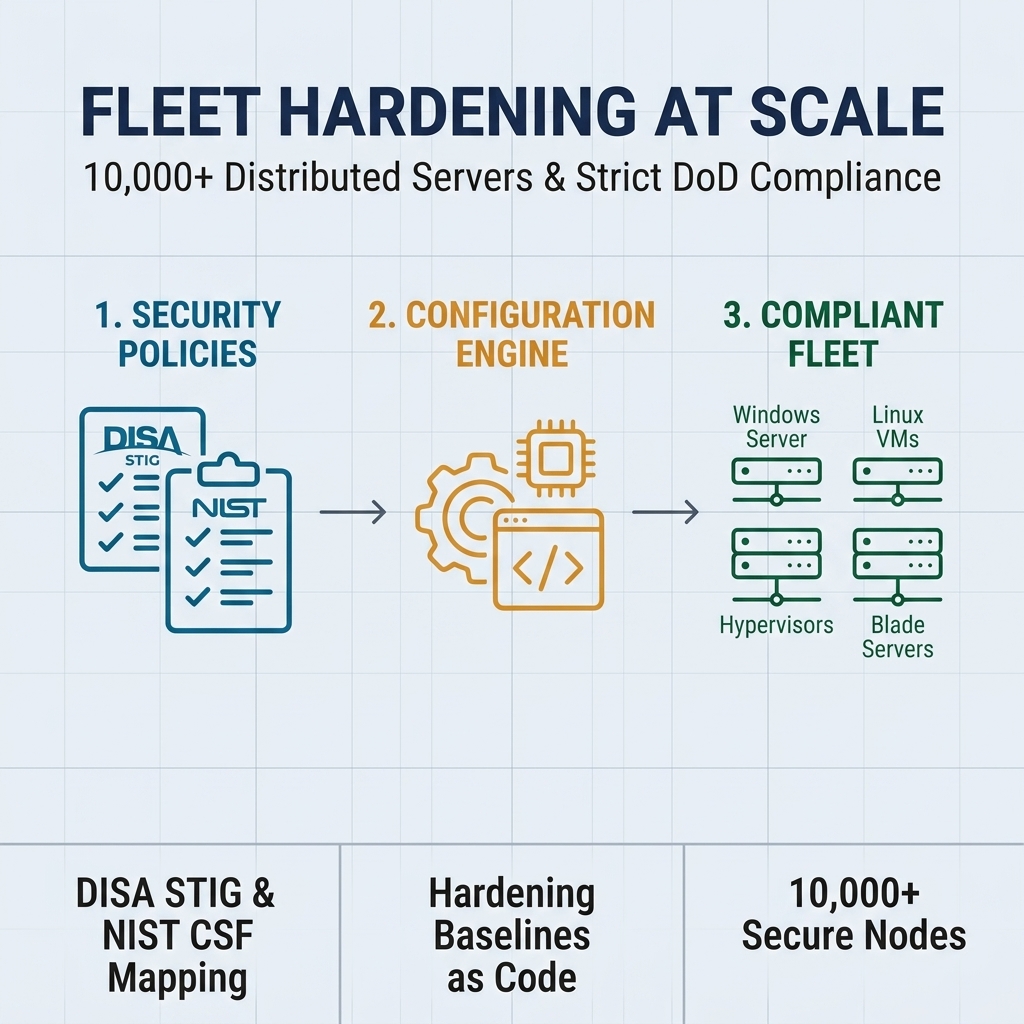
Running a patch script on a few dev servers is straightforward. Keeping a Defense Health Agency (DoD) fleet of 10,000+ virtual servers hardened, patched, and compliant across 18 distributed locations is a completely different kind of pressure.
When you're managing a mixed Windows Server and Red Hat Linux (RHEL) environment under strict military guidelines, success isn't about working faster. It's about building repeatable baselines that refuse to drift.
Here is how we maintained security hygiene across this footprint:
- Strict DISA STIG & NIST CSF Mapping: No guesswork or cowboy patching. Every configuration change, update, and system lockdown was mapped directly to compliance frameworks and validated.
- Hypervisor-Agnostic Execution: Orchestrating updates seamlessly across both VMware ESXi and Hyper-V host clusters while keeping mission-critical systems online.
- Hardening Baselines as Code: Treating security templates and profile baselines like code to automatically detect and eliminate configuration drift between geographically isolated clusters.
In high-security environments like the DoD, security compliance overrides everything. But the real engineering headache is execution: what happens when a mandatory DISA STIG rule conflicts with a legacy application dependency that you physically cannot upgrade?
How do you enforce consistent hardening baselines when your server fleet is split across different operating systems, hypervisors, and geographically isolated locations?