
Bare Metal Deployment Optimization
Beating a tight project schedule by an entire week usually doesn't happen by working faster. It happens by standardizing chaos.
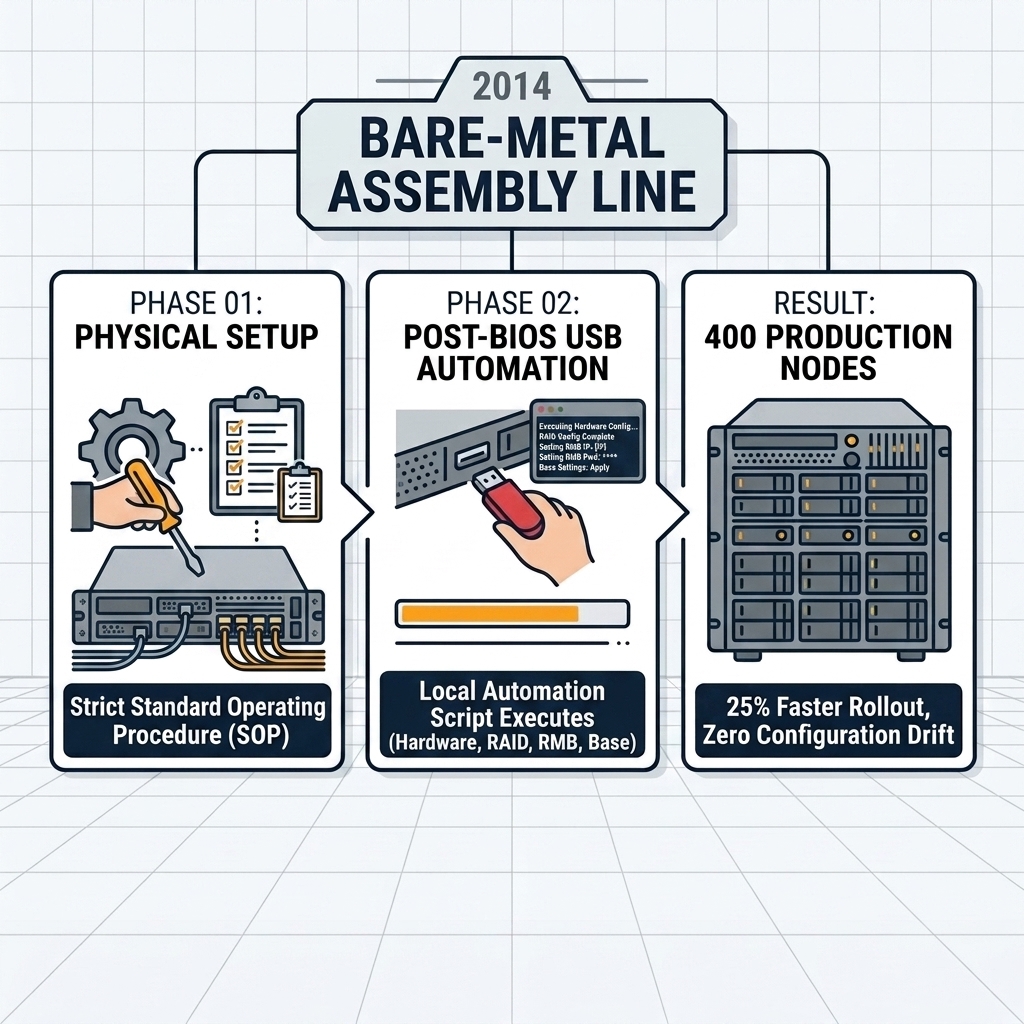
Back in 2014 at Microsoft, we faced a challenging rollout: deploying 400 bare-metal servers on the datacenter floor. The kicker? Centralized hardware configuration tools were completely restricted for this project due to security policies. We couldn't configure settings over the network. Everything had to be done locally at the rack: manual RAID arrays, Remote Management Board (RMB) IP addressing, and base firmware settings.
When you multiply that level of manual intervention by 400 servers, human configuration drift and timeline slippage are practically guaranteed.
To keep the project on track, I designed a localized "assembly line" process combining a strict manual checklist with bootable USB hardware automation:
- The Standard Operating Procedure (SOP): I built a rigorous, step-by-step checklist for the physical racking, cabling, and initial setup. This turned a chaotic hardware configuration into a repeatable assembly line process.
- Hardware Configuration USB Automation: Instead of manually configuring settings through BIOS menus on 400 distinct local consoles, we booted servers directly from USB drives running post-BIOS automation scripts. These scripts automatically configured the RAID arrays, set the Remote Management Board (RMB) IP addresses, updated firmware baselines, and configured management passwords, preparing the bare metal for the standard OS deployment image (managed by a separate team).
The result of combining a tight physical workflow with localized script execution was a game changer:
- Speed: We cut the average server commissioning time by 25%.
- Delivery: The assembly line allowed us to hand over all 400 production-ready nodes to the product team an entire week ahead of schedule.
Infrastructure automation isn't always about massive, cloud-scale orchestration platforms. Sometimes, real-world engineering is about looking at a physical bottleneck, standardizing the manual steps, and scripting whatever you can with the tools you have in your pocket.
For anyone who has spent time racking and provisioning bare metal: what's the most creative local automation hack you've had to build directly on the datacenter floor when standard network deployment tools weren't an option?