
Architecting in a Government Cloud
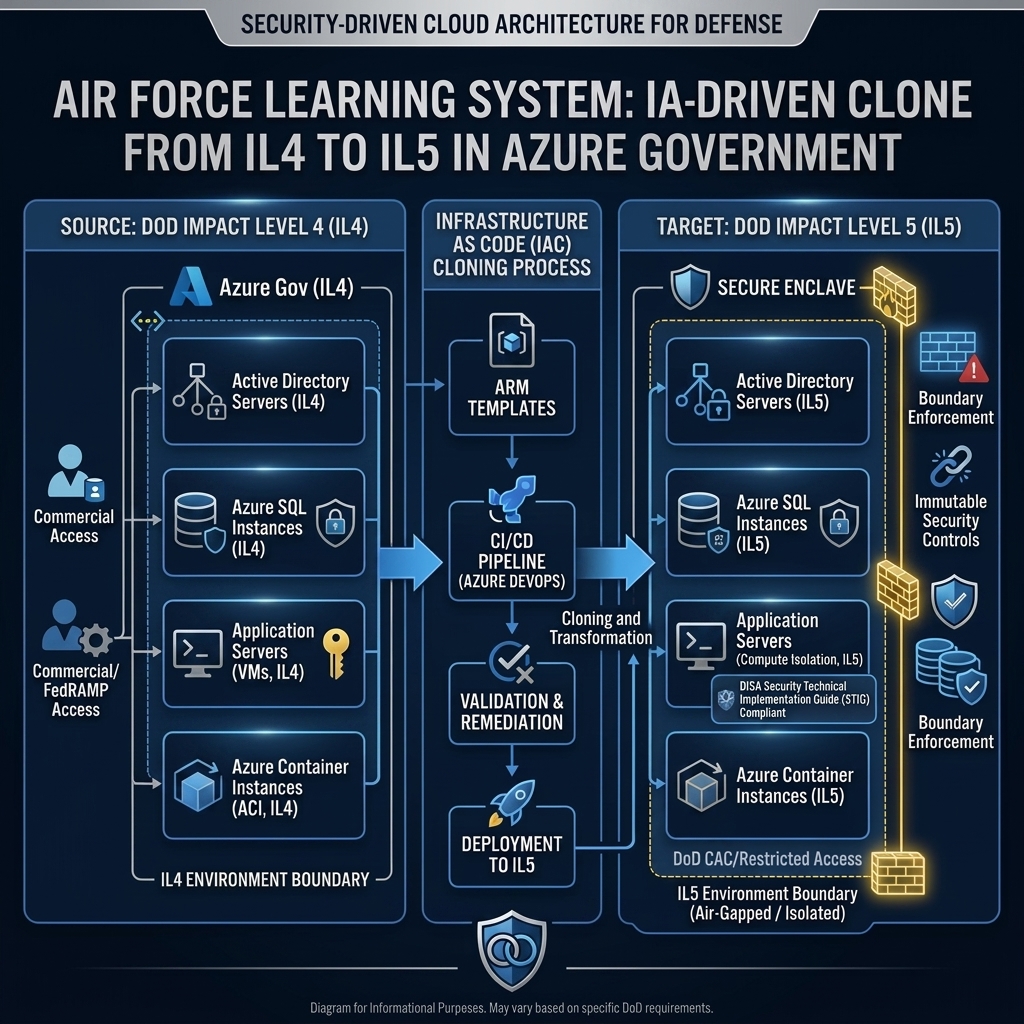
Building cloud infrastructure for commercial apps is one thing. Architecting it to meet federal and defense-grade security baselines is an entirely different sandbox.
When deploying the infrastructure for the Air Force learning system in Azure, the priority was not just uptime. It was navigating strict compliance boundaries, data sovereignty, and unpredictable feature isolation.
Engineering in a sovereign cloud environment comes with distinct architectural constraints that you do not encounter in commercial regions:
- The Feature Parity Gap: FedRAMP and Azure Government environments inherently suffer from feature lag. You cannot simply pull a new commercial PaaS tool off the shelf. You have to architect solutions with the assumption that certain tools are delayed or missing entirely.
- IL4 vs. IL5 Realities: There is a massive operational divide between DoD Impact Levels. While IL4 maps closely to commercial Azure tooling, jumping to IL5 changes the game completely regarding compute isolation, strict boundary enforcement, and restricted API endpoints.
- Immutable Security Controls: Relying on rigid Infrastructure as Code (leveraging ARM templates and custom PowerShell post-boot scripting) to lock down the environment, eliminate configuration drift, and ensure that every deployment satisfies strict federal compliance baselines out of the box.
When you are operating at this level, security and compliance dictate your architectural boundaries from day one. You do not build first and secure later.
For those working in defense, GovCloud, or highly regulated sectors, how do you handle architecture planning when dealing with unexpected service gaps between commercial and government clouds?